Current trends in the pharmaceutical industry are all about the adoption of advanced technologies right from production to distribution and all the way to patient care.
In the era of digital transformation in pharma, automation, interconnectivity, and AI are gaining ground, paving the way to the future of drug production.
Technological Advancements Are The Key Trends In The Pharmaceutical Industry
Nowadays, current pharma trends are all about efficiency, optimization, compliance, and personalization on every level: from R&D to distribution and from ground-breaking pharmaceuticals to proactive care.
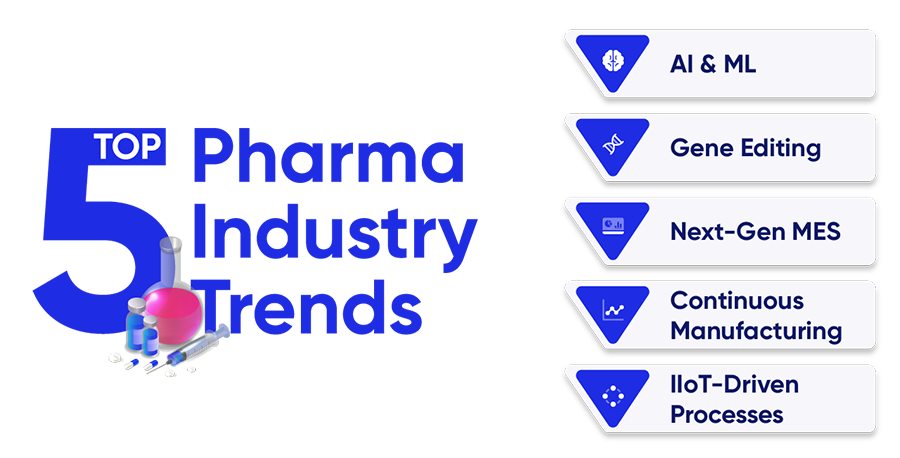
Top 5 Pharma Trends - Infographic
Narrowing it down, here's our pick of the most significant pharmaceutical trends for the coming year.
Artificial intelligence (AI) And Machine Learning (ML)
Today, AI and ML are increasingly used in all the different stages of drug development.
During drug development, for example, Artificial Intelligence and Machine Learning analyze vast datasets in order to identify promising drug targets and create new drug compounds.
In many cases, they are programmed to identify how to repurpose existing pharmaceuticals for different conditions, which is much faster and less costly than new drug development.
For products already in use, ML and AI offer personalized treatment plans by analyzing and evaluating patient history data.
Gene Editing Technologies And Cell Therapies
Technologies such as CRISPR-Cas9 are changing the game for drug development through precise modifications of DNA sequences that produce targeted therapies for genetic diseases.
Scientists see here a promising potential to cure previously untreatable diseases, offering hope for patients with genetic disorders, cancer, and other life-threatening conditions.
Presently, however, there are some core challenges associated with these: manufacturing complexity, high costs, and onerous regulatory approval paths.
Next-Gen Manufacturing Execution Systems (MES) For Pharma
Intelligent MES solutions work as a central hub that connects and manages various shop floor systems and processes within pharmaceutical manufacturing.
Key benefits of trending AI IIoT MES software include:
Ecosystem Connectivity and Orchestratio
MES platforms act as the central hub in the manufacturing ecosystem - connecting systems, like EBRs (Electronic Batch Records) and machine data connectivity. Their unified view of operations helps orchestrate processes for smooth execution and data flow across different stages of production.
Real-time Monitoring And Control
Real-time data from production lines enables teams to monitor processes closely, identify deviations well in advance, and implement interventions way ahead of time.
Data Analysis and Performance Management
In-depth data analysis is not new to the pharmaceutical industry. However, IIoT MES platforms can now capture an enormous volume of production data that accurately identifies trends and bottlenecks while aiding decision-making.
Digital Platforms For Patient Engagement
Among the latest pharma marketing trends, app-based personalized communication strategies significantly raise patient experiences and improve healthcare with:
- Personalized information on medication.
- Personalized patient care.
- Patient access to educational resources.
- Tools for self-management.
- Support for medication adherence.
- Channels for collecting patient feedback.
By leveraging digital communication channels, pharmaceutical companies can empower patients, improve treatment outcomes, and build stronger patient relationships.
Continuous Manufacturing
The pharmaceutical industry is moving away from traditional batch manufacturing. Some say that the future of the pharmaceutical industry lies in continuous manufacturing processes - a production model that enhances efficiency in drug production while lowering costs.
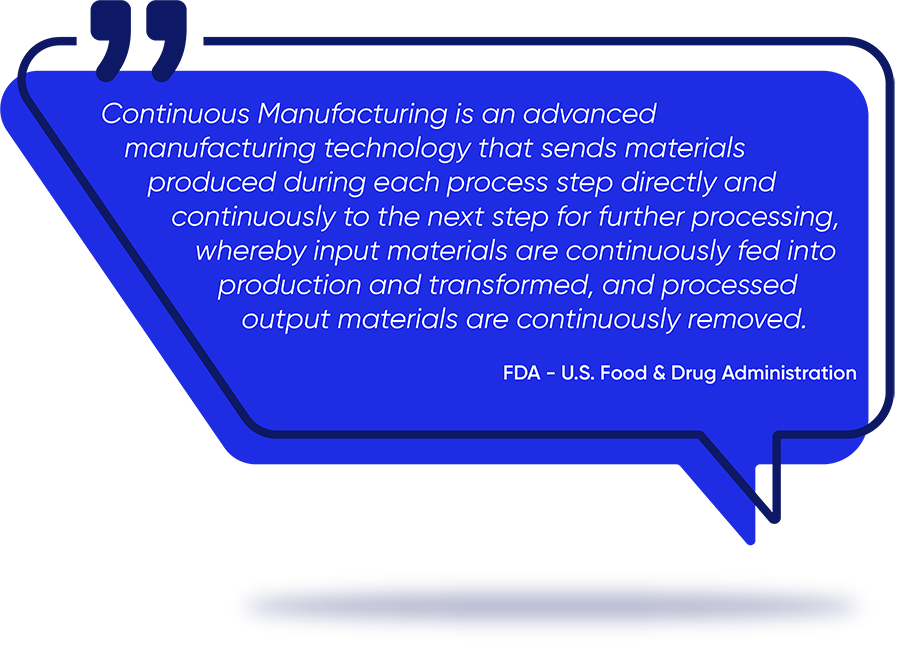
What is Continuous Manufacturing? A definition by FDA.
This constant flow of materials and production steps supports the quality of pharma production by means of:Improved Efficiency
Continuous manufacturing eliminates downtime between batches, so production schedules are optimized with shorter lead times.
It also minimizes material losses associated with start-up, shutdown, and changeovers in batch production.
Increased Flexibility And Customization
Continuous systems are inherently flexible and can accommodate changes in production volumes and product formulations with minimal adjustments. In other words, it’s now easier to ramp up or scale down production in response to market demand - providing companies with greater agility.
Enhanced Quality Control
Continuous processes allow for real-time monitoring and control and precise adjustments to reaction conditions as needed - safeguarding product quality consistency and compliance adherence.
With real-time monitoring, operators can immediately detect and correct any deviations from the expected process parameters - maintaining product safety and integrity.
IIoT-Driven Trends In Pharma
The convergence of connected devices is transforming end-to-end pharma operations. Unavoidably, IIoT systems are among the top trends in the pharmaceutical industry today.
For example, IIoT in pharma is used in:
Cleanroom Monitoring
IIoT sensors monitor environmental conditions in cleanrooms, ensuring strict regulation compliance and product quality.Machine Data Connectivity
Connected manufacturing equipment collects and analyzes data to provide real-time insights into machine performance and potential issues.Digital Work Instructions And Checklists
IIoT-enabled platforms digitize work instructions and checklists to ensure consistency and continuity of tasks with minimal human error.Overall Equipment Effectiveness (OEE) Monitoring
Advanced equipment performance monitoring in pharma is the key to operational excellence and process optimization.Serialization and Aggregation
IIoT systems track and trace pharmaceutical products throughout the supply chain to avoid counterfeiting and ensure product authenticity.
With more interconnected applications coming, IoT is profoundly transforming the pharmaceutical industry, driving innovation across the entire value chain.
Expanding On Innovations: Future Trends In Pharmaceutical Industry
As technology is gaining ground throughout healthcare, pharmaceutical innovations seem to meet no borders. In this rapidly evolving environment, many industry professionals are already shaping operations around future pharma trends.
3D Printing For Personalized Medicine
3D printing is set to revolutionize pharmaceutical manufacturing. Customized 3D-printed drug formulations can meet the specific needs of individual patients, especially in rare diseases.
More so, printed tablets with complex designs allow for the controlled release of medications, they improve drug efficacy and also patient adherence.
Nanotechnology
An emerging field in pharma nanotechnology creates nanoparticles that can carry medications directly to targeted cells or tissues, enhancing drug effectiveness and minimizing side effects.
At the same time, nanosensors for disease diagnostics can detect a variety of conditions at an early stage with high accuracy.
Wearable Technology
Wearable devices can continuously track patients' vital signs and health data and provide insights on disease progression and response to treatment to healthcare professionals and patients themselves.
As innovative technologies continue to grow, pharma trends will eventually adopt even more groundbreaking advancements in drug development, manufacturing, and patient care.